Henry
Edward Hickmott
(1852-1931)
Return to Samuel Hickmott
Return to First Families Home Page
Henry Edward Hickmott was the only son of Henry Hickmott
and Sophia Goldsmith. He was born at Mount Barker in South Australia on 17 May
1853. When he was three years old, he moved with his father and stepmother to
Clunes in Victoria where he lived for a few years before moving to Charlton.
Henry Edward married
 Elizabeth Ann Owen in Kingower on 24 April 1877 but
continued to reside in Charlton where he worked as a farmer, brick maker and
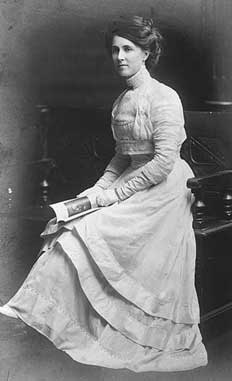
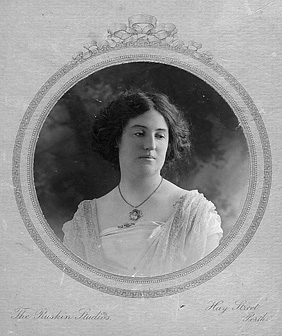
builder. Elizabeth (shown in the photo) was born at Emerald Hill in Melbourne
on 15 July 1855 and was the second child of Edward Owen, a miner, and Elizabeth
Evans. Edward
Owen was born near Bangor and Elizabeth in Montgomeryshire both in Wales. They
met and married in 1849 in Liverpool, England from where they emigrated to Australia in 1852 on
either the PORT STANLEY or WANATA.
Elizabeth Ann Owen in Kingower on 24 April 1877 but
continued to reside in Charlton where he worked as a farmer, brick maker and
builder. Elizabeth (shown in the photo) was born at Emerald Hill in Melbourne
on 15 July 1855 and was the second child of Edward Owen, a miner, and Elizabeth
Evans. Edward
Owen was born near Bangor and Elizabeth in Montgomeryshire both in Wales. They
met and married in 1849 in Liverpool, England from where they emigrated to Australia in 1852 on
either the PORT STANLEY or WANATA.
Lured by the news of fresh discoveries of gold in the
Kingower-Inglewood region in the late 1850s, Edward, or Taffy as he was known,
and his family moved from Melbourne to Bet Bet near Dunolly in around 1857
(where their son John Richard was born) and then to Kingower. The old couple
remained there through the town’s boom and bust periods - the population of
Kingower peaked at around 8000 in the 1860s before declining to just 100 by the
time of Edward’s death in 1908. His wife Elizabeth died in Kingower in 1893.
At the time of Henry Edward’s marriage, the township of
East Charlton boasted two mills, two restaurants and five hotels, the latter
being: Klug’s East Charlton Hotel, the Globe Hotel, the Golden Fleece, the
Telegraph and the Cricket Club Hotel. It is likely that Henry, his brothers
James and William and brother-in-law John Richard Owen frequented the last of
these establishments, if not for imbibing or playing billiards, then certainly
for planning and issuing challenges to such opposing cricket teams as St.
Arnaud, Donald, Mount Jeffcott and Buckrabunyule. Unlike John Owen, who was
said to play for Victoria,[1]
Henry was what was described by the East Charlton Tribune as a ‘trundler’ who sometimes
‘disturbed the peace’ of his opponents’ ‘timberyard’ and, very occasionally,
scored a few runs. Perhaps his most notable performance was against St Arnaud
on 20 October 1879, where he took 2/19 and participated in a last wicket stand
which resulted in an historic win over East Charlton’s arch rivals. The joy of
winning was to be short lived, however, as East Charlton – and Henry’s bowling
- were thrashed in a return match held at St Arnaud a couple of weeks later.[2]

The Lalbert Cricket Team in 1900
As numbered: 1. Joe Nalder, 2. Dick Smith, 3. Local Minister, 4. Local School Teacher,
5. Henry Edward Hickmott, 6. Mat Nalder, 7. Donald Kennedy, 8. Al Smith,
9. Billy Nalder, 10. George Nalder, 11. Charlie Smith, 12. Phil Willoughby,
13. George Hickmott, 14. Tom Power and 15. Billy Hickmott.
While Henry Edward would have helped his father on the latter’s farm, it is likely that, while at Charlton, he worked mostly as a brickmaker and builder. His main customer would have been the local businessman Peter Johnson who, as Grace Cadzow describes, ‘kept the town’s brickmakers almost constantly employed in making bricks for his [various] constructions’ around the place.[3] Henry and his brothers continued to play cricket for Charlton which, by the 1880s, had become ‘a progressive town’. Steps had been taken to give it ‘a better appearance by forming streets and footpaths’ which prevented bullock drays and other heavy vehicles being bogged in the town winter. Kirk’s coach factory had commenced business and a Mechanics Institute was opened in 1883, ‘providing Charlton residents with meeting and reading rooms [that were] well stocked with books and daily and local newspapers’ (Cadzow, p.17). On 20 April 1883, the railway line joining Charlton to Cope Cope was finally opened and, while the visiting dignatories were wined and dined in a specially erected marquee, Henry Edward and members of his by now large family - comprising Sophia Elizabeth, John Edward, Edward James, Florence Mary, Alice Ann, Edith Olive, William Henry, George Alfred, Ruby Minnie and Ella Adeline - would have joined the other residents of the town in taking the free train ride to Korong Vale and back.
In 1891 Henry Edward and Elizabeth and their family moved
onto a farm near Lalbert where Henry’s sister Rebecca Smith and her family had
lived since moving there from Waubra in 1878. The adjoining property was owned
by Samuel and Frances (‘Fanny’) Free whose eldest daughter Frances would marry
Edward and Elizabeth’s son William Henry in 1910. Henry Edward and Elizabeth
Hickmott stayed in Lalbert for some eighteen years. During this time, Henry was
responsible for getting the government to establish a school in the area,
served as the Secretary of the Lalbert Farmers Association, seemed to be
involved in local politics, and, of course, continued to play cricket.
In spite of these interests, Henry and Elizabeth decided,
in 1909, to sell up and move to Western Australia where they purchased a farm
near Brookton (four of their grown-up children - Sopia Eliza, William Henry, John Edward
and Edith Olive - declined to go with the family and stayed in Victoria). As at
Lalbert, Henry soon became actively involved in the local community, serving as
a founding member of the Brookton Farmers and Settlers Association and its
President for two years. On 21 October 1914, he was elected as the member for
Pingelly in the Western Australian Parliament where he sat for three terms
before being defeated at the 1922 general election. The following year Edward's wife, Elizabeth, died while visiting her son William Henry and his family in Victoria and was buried at Ouyen. Eight years later, on Sunday 18 January 1931,
Henry Edward was killed when he was thrown from a cart. He was laying rabbit
poison on his property when the cart hit a stone and he was thrown to the ground,
breaking his neck. His funeral took place the following day and he was buried
in the Methodist section of the Brookton Cemetery.

Henry Edward and Elizabeth Ann Hickmott (nee Owen)
and their youngest son Authur in c1908
William Henry Hickmott and Frances Alice Free
William, born at Charleton on 6 October 1887, was the
sixth child of Henry Edward and Elizabeth Hickmott. When he was a small boy,
William moved with his family to Lalbert where he attended State School No 2990
with his brothers and sisters and cousins from the Smith family.[4]
While he was there, the original school was closed down and, following
petitions from the parents, a replacement was built at a more central location.
According to a letter written to the Education Department by William’s father,
the new school was to be ‘twenty-six feet by thirteen [with] eight foot walls,
iron roof [and a] hardwood floor’. It was to have ‘walls of bush pine … two
windows, one door, spouting all around and lined and ceiled throughout’.[5]
The numbers of people living in the district during this
time were relatively small and this, together with poor transport and great
distances between properties, made it inevitable that adjoining families would
intermarry. This had been the case with the Frees and the Shepherds in Corack
and was to be so again with the Hickmotts. Two of William’s sisters, Sophia
Elizabeth and Edith Olive married George William Lewis and Herbert Digby Lewis
in 1898 and 1903 respectively. Herbert Lewis, said by many at the time to be
the best saddler in the Mallee, owned a shop and house in Lalbert. William’s
brother, John Edward Hickmott, married a daughter of William and Margaret Free,
Eliza Ada, in 1903. And, on 29 June 1910, William married Eliza’s cousin, Frances
Alice Free, in the dining room of her parent’s home at Lalbert East. Frances
was the eldest daughter of Samuel and Fanny Free and lived on a farm adjoining
that of the Hickmotts. According to Win Noblet:, she and William
made a handsome couple. Frances looked beautiful
in her dainty lace and taffeta frock with tiny pleats and rich lace edging. Her
elaborate headdress and veil were held in place with orange blossom. After the
ceremony William and Frances drove by horse and buggy to take up residence in
their first home

William Henry Hickmott and and Frances Free
Lalbert 29 June 1910
The year before William and Frances were married,
William’s parents Henry Edward and Elizabeth sold their farm at Lalbert and
moved with some of their family to Western Australia. William, his brother John
and sisters Sophia and Edith elected to stay in Victoria. William subsequently
spent a good deal of his time helping his cousin, John Albert Smith, clear a
block of land Smith had bought at Wornack, to the southeast of Ouyen. Attracted
by the prospects of good wheat harvests, William applied for another block in
the same area and, following the birth of the couple’s second child, Gladys
Elizabeth in June 1912, he and frances loaded their meagre possessions plus some
provisions and necessary tools onto a waggon and drove the 110 miles to Al
Smith’s block where they lived until their application was approved. Their time
at Wornack lasted nearly two years and, in order to survive, William worked for
other settlers clearing the Mallee scrub, building fences and performing any
other jobs that became available.
William and Frances were eventually granted a 640 acre
block of land located to the northeast of Ouyen, and moved there not long after
their fourth daughter, Florence Evelyn, was born on 13 July 1915. They
initially lived in a small and primitive wooden hut that William had
constructed out of logs cut from the surrounding trees. Limited finances meant
that William had to continue to seek work elsewhere as well as clear and
develop his own property. This meant that Frances and the children were often
left by themselves for long periods of time. While Frances was very much a
country girl, used to the demands of outback life, the still unfamiliar
surrounds combined with her utter isolation and fears of marauding dingoes and
other animals, made this a very trying and difficult time for her. As Win
Noblet described:
naturally in unfamiliar surroundings and amid the
howling dingoes she was afraid. The little girls were terrified and Frances
would clutch her little children while keeping a wary eye on the closed door,
anticipating any minute it would burst open and the vicious dingoes would
attack. … [Their little greyhound Bella] was [also] afraid of the dingoes and
the unknown terror of the inky black scrub, and would be acratching at the
door, pleading for protection and the warmth and comfort of his masters voice.
But Frances was so afraid and although she loved all small things [she]
couldn’t bring herself to unlock the door and let little Bella in.

William and family outside their house

William and Frances Hickmott’s five eldest girls – Grace, Gladys, Elsie, Muriel and Florence – taken during a visit to Western Australia.